Deployable space infrastructure
We build the large structures the space economy runs on.
GAMA WING
DEPLOYMENT SIMULATION
DEPLOYMENT SIMULATION
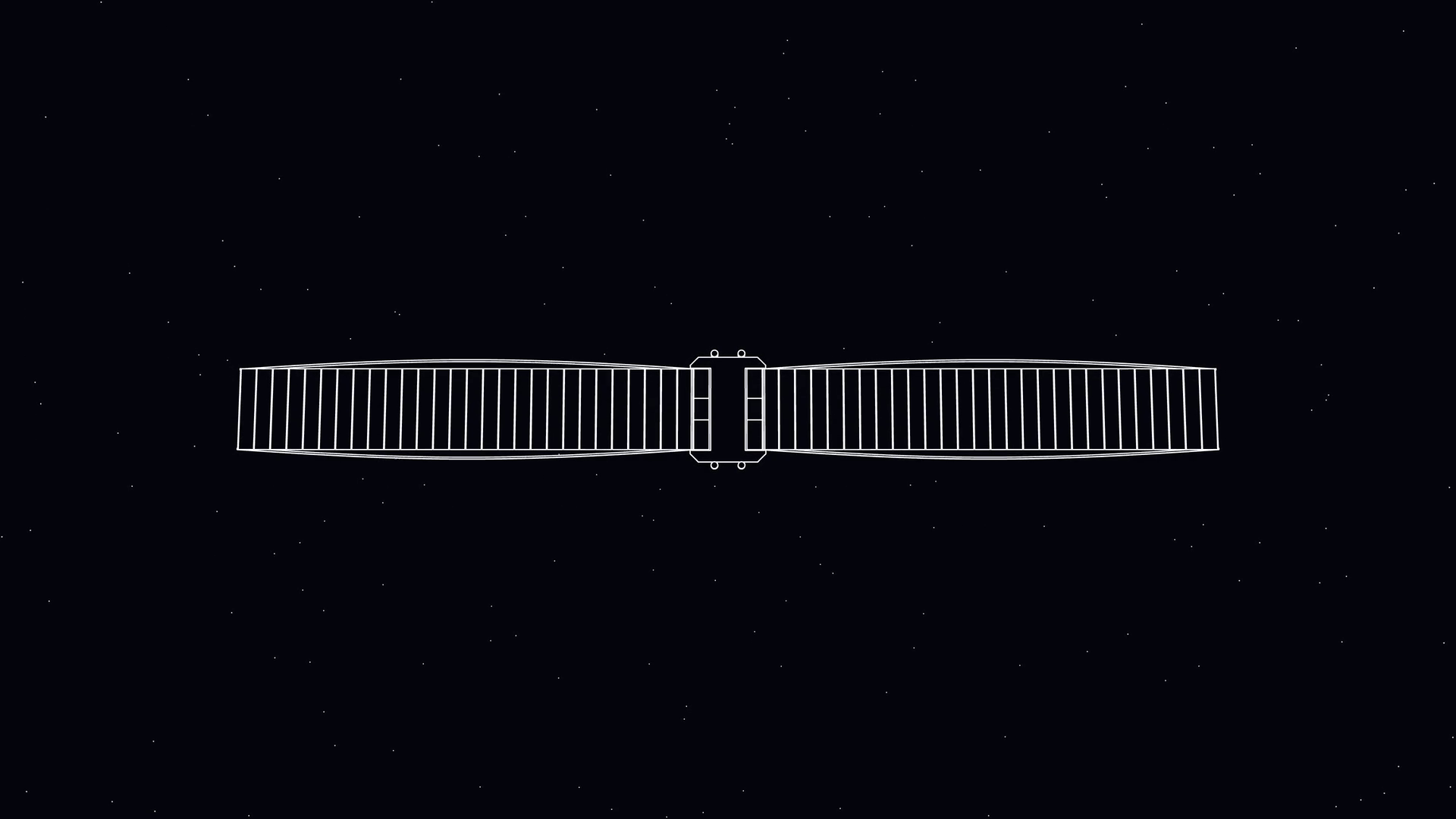
We build the large structures the space economy runs on.
Constellations need orders of magnitude more power per spacecraft to compete. Solar arrays have been hand-built and quoted in years, forcing teams to compromise.
Starlink proved that power at scale wins in orbit. It also proved the arrays would have to be built in-house, because no supplier could deliver. We are the partner that can.
From Vanguard 1 to the International Space Station, every array was artisanal. Cumulative capacity crawled.
Starlink added roughly 215 MW in seven years by building its arrays in-house, at production rates.
Everything ever launched since 1958 equals about two to three hours of Earth's current solar installation rate.
Demand is breaking upward again: next-generation constellations and orbital data centers, GW-class.
In space, the physics rewards structures that are large and flat, not constrained by the rocket fairing diameter.
GAMA is an engineering-first company, manufacturing structures that launch folded and unfold to hundreds of square meters in orbit, with the software to control ever larger structures. That is core to every product we make. The first product is power in Space.
Gama Wing is a modular solar array family, designed and manufactured for constellation production rates, from 3 kW to over 100 kW per array wing. Every unit is acceptance tested on site before it ships for integration: standard interfaces, complete test data, no surprises at your facility or in orbit.
And because power does not stop at the array, Wing is available as a complete power system: array, MPPT power conditioning and batteries, delivered as one qualified unit.
We are designing for one number above all: cost per watt.
† DESIGN-STAGE VALUES AND DATES.
10 MWANNUAL ARRAY OUTPUT · TARGET
Space solar arrays are still built the way spacecraft were built in the 1980s: by hand, one program at a time. We are industrializing them.
We are building Factory 02, our next production facility, designed for 100 MW of annual array output: series manufacturing from day one, repeatable processes, automated test, acceptance data with every unit. Factory 03 is targeting 1 GW annual.
Not a lab that ships occasionally. A factory.

CEO
Mentor to numerous space companies. Scaled a now publicly listed global consumer company, with supply chains and manufacturing across Europe and Asia.
LinkedIn ↗
CTO
Designed star trackers and lasers for volume manufacturing at SpaceX, and the core GNC software behind precision pointing.
LinkedIn ↗
Head of Business Development
Deep expertise selling complex hardware into the automotive industry, where cost, quality and volume discipline are non-negotiable.
LinkedIn ↗
VP of Engineering
Engineered SpaceX antennas and scaled user-terminal manufacturing to millions of units.
LinkedIn ↗Engineers and builders in Paris, designing, testing and manufacturing spacecraft hardware, with a factory to stand up and missions on the manifest.